
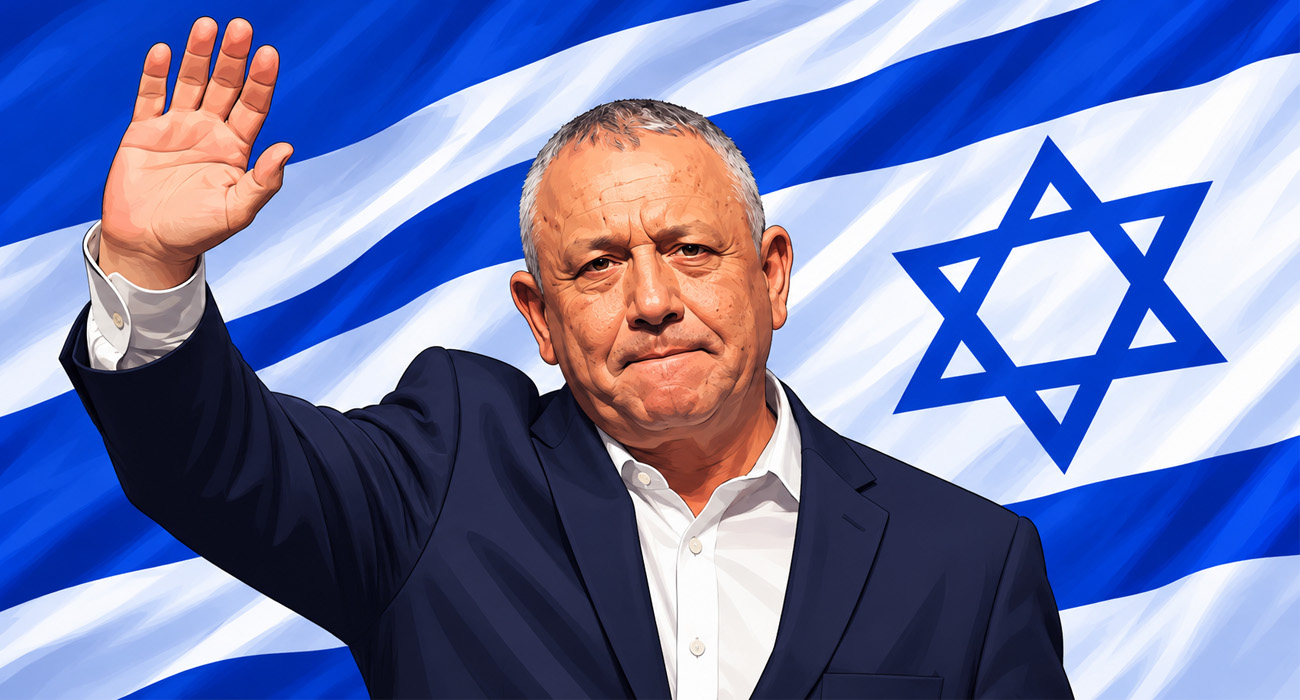
JERUSALEM, Israel – Israeli President Isaac Herzog has tasked opposition leader Gadi Eisenkot with forming a new government following last month’s parliamentary elections, putting Prime Minister Benjamin Netanyahu’s political future in doubt after years of dominating Israeli politics.

Herzog announced the decision Saturday, Nov. 7, giving Eisenkot, a former military chief and leader of the Yashar party, the first opportunity to assemble a governing coalition after the Oct. 27 election failed to produce a clear parliamentary majority.
The decision represents a significant setback for Netanyahu, Israel’s longest serving prime minister, whose governing alliance lost its majority in the 120 member Knesset.
However, Eisenkot’s appointment does not automatically make him prime minister. He must secure enough parliamentary support to form a government, a difficult task given the deep political divisions that have emerged following three years of conflict in Gaza and elsewhere in the Middle East.

Election Results Leave Israel Politically Divided
The election produced a fragmented parliament, with neither Netanyahu’s governing alliance nor Eisenkot’s opposition bloc winning the 61 seats required for a majority.
Netanyahu’s Likud party emerged as the largest single party with 27 seats, but his broader alliance of right wing and religious parties secured only 53 seats.
Eisenkot’s opposition bloc, comprising four Jewish led parties, won 48 seats. Meanwhile, two Arab led parties made historic gains, securing a combined 19 seats and potentially placing them at the center of negotiations over Israel’s next government.
During consultations with Herzog, 67 lawmakers recommended Eisenkot to form the next government, compared with 46 who supported Netanyahu.
The endorsements strengthened Eisenkot’s position, but they do not guarantee that all 67 lawmakers will support the same governing coalition.
Several parties remain divided over whether they can cooperate, particularly on the role of Arab political representatives in Israel’s government.
Arab Parties Could Determine Israel’s Next Government
The strong performance of Arab led parties has become one of the most significant developments following the election.
Their combined 19 seats could provide the support Eisenkot needs to end Netanyahu’s leadership. Yet cooperation remains politically sensitive.
Arab parties have participated in an Israeli governing coalition only once, and some parties aligned with Eisenkot have already expressed opposition to forming a government that depends on their participation.
One possible arrangement would involve establishing a minority government with support from Arab lawmakers who remain outside the formal coalition.
Another option would be a broader unity government involving major Jewish political parties, potentially including Netanyahu’s Likud.
Both approaches face substantial obstacles.
Eisenkot has indicated that cooperation with Arab parties would depend on certain conditions, including their position toward Hamas, while members of his own political bloc remain divided over such an arrangement.
The negotiations are therefore likely to test whether the opposition’s shared determination to replace Netanyahu is strong enough to overcome disagreements over security, national identity and political representation.
Netanyahu Calls for Unity Government
Netanyahu has responded to the political uncertainty by calling for a national unity government, warning against the formation of an administration supported by Arab led parties.
In a video statement released shortly before Herzog’s announcement, Netanyahu warned against bringing what he described as supporters of terrorism into government, language he has repeatedly used when criticizing Arab political parties.
His comments followed allegations by Netanyahu and his allies that Arab parties had manipulated the election results.
However, Israel’s Central Election Committee said its investigations had found no evidence of irregularities that compromised the integrity of the vote or changed its outcome.
Herzog accepted the certified election results on Nov. 4, clearing the way for formal consultations on the formation of a new government.
The president has also called for political compromise and condemned inflammatory language directed at Israel’s Arab population.
Gaza War and Military Service Dispute Shape Coalition Talks
The struggle to form a new government comes as Israel continues to grapple with the consequences of the Hamas led attacks of Oct. 7, 2023, and the subsequent wars in Gaza and the wider region.
The attacks, which killed about 1,200 people in Israel and resulted in 251 hostages being taken, remain central to the country’s political debate.
Netanyahu has faced criticism over security failures surrounding the attacks and his opposition to a formal independent investigation into the events.
Eisenkot and several opposition figures have supported such an investigation, creating another major disagreement between the two political camps.
Military service exemptions for ultra Orthodox Jewish men have also emerged as a serious obstacle to coalition negotiations.
Netanyahu has traditionally depended on religious parties that support exemptions for their communities. Eisenkot, whose son was killed while serving in Gaza, has opposed the exemptions.
The dispute has already weakened Netanyahu’s position, with United Torah Judaism, a longtime political ally, declining to endorse either candidate during the president’s consultations.
These disagreements could make it difficult for Eisenkot and Netanyahu to reach a power sharing agreement, even if both face pressure to prevent another election.
What Happens Next?
Eisenkot will initially have 28 days to form a government, with the possibility of a 14 day extension, giving him a maximum of six weeks to secure the parliamentary support he needs.
During that period, he must negotiate agreements with parties whose positions differ sharply on national security, religious obligations, political reform and relations with Arab citizens.
If he fails, Israel’s political process allows for further attempts to form a government. Should those efforts also fail, the country could face another general election.
Netanyahu will remain prime minister in a caretaker capacity until a new government is formed.
For now, Herzog’s decision has moved Eisenkot closer to power, but the election’s outcome remains unresolved.
The coming weeks will determine whether Israel can establish a new governing coalition, reach a compromise between rival political camps or return to the polls.
For Netanyahu, the stakes are particularly high. Losing power would mark a major turning point in a political career that has shaped Israel’s domestic affairs, security policies and relations with the wider Middle East for decades.
No part of this publication or its digital content may be reproduced, distributed, published, broadcast, rewritten, or redistributed in whole or in part without prior written permission from Kalisho Info.
For inquiries, contact: kalishoinfo@gmail.com
Stay informed and ahead of the curve! Follow Kalisho Info for real-time updates and breaking news.