
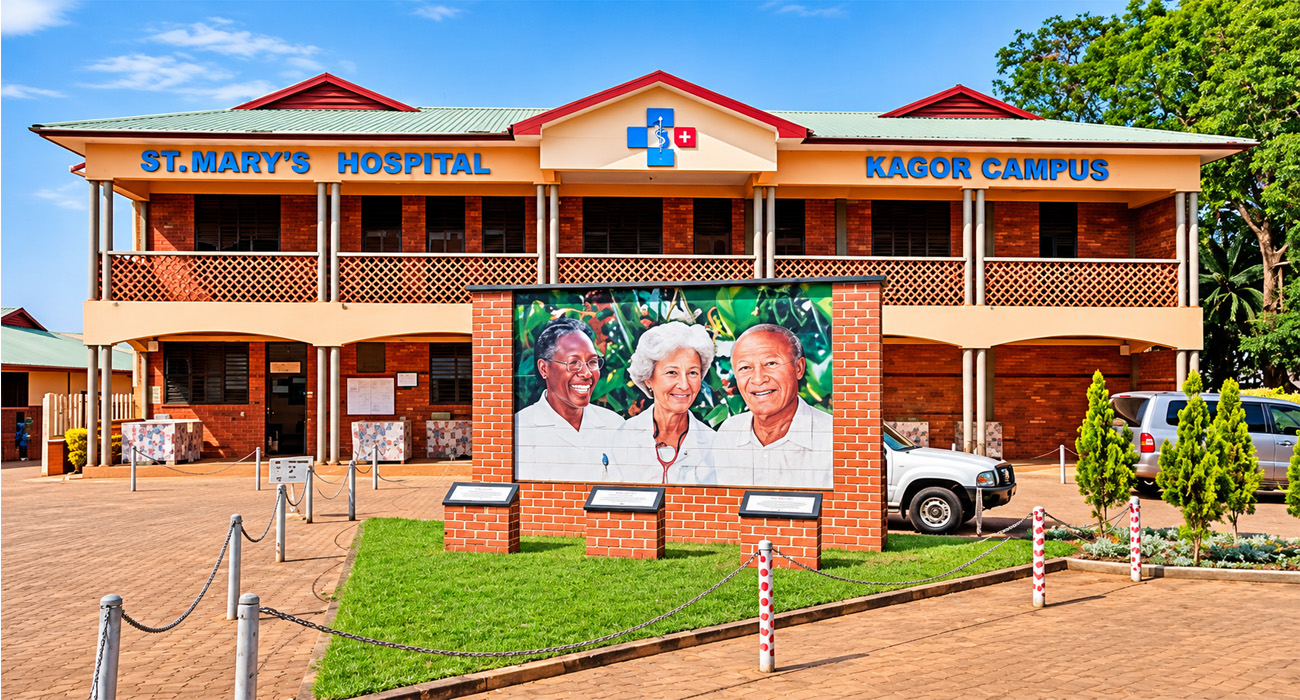
GULU, Uganda – St. Mary’s Hospital Lacor has once again earned national recognition, emerging as the best general hospital in the Ministry of Health’s Annual Health Sector Performance Report for the 2025/26 financial year.

The recognition highlights the hospital’s commitment to quality, affordable health care, particularly in northern Uganda, where access to specialist treatment remains a challenge.
Founded in 1959 by Comboni missionaries under Bishop Giovanni Battista Cesana, the hospital began as a modest 30 bed facility near Lacor village, west of Gulu City.
Its transformation began in 1961 when Italian pediatrician Dr. Piero Corti took over its management. He was joined by Canadian surgeon Dr. Lucille Teasdale, whom he married that December. Together, they built the hospital around a simple vision: providing the best possible care to the greatest number of people at the lowest cost.

More than six decades later, that vision remains alive. A cesarean section reportedly costs just 25,000 Ugandan shillings, a consultation 7,000 shillings and a day in intensive care 30,000 shillings. Patients unable to pay can also receive treatment under the hospital’s fee waiver policy.
Such affordability stands in sharp contrast to some private nonprofit hospitals, where comparable procedures can reportedly cost 1 million shillings or more. But keeping treatment affordable comes at a heavy financial cost.
Despite treating hundreds of thousands of patients annually, Lacor continues to struggle with limited government support, rising operational costs and growing uncertainty over donor funding.
The hospital has endured some of Uganda’s darkest periods, including Idi Amin’s dictatorship and the Lord’s Resistance Army insurgency. During the conflict, it faced looting, threats and staff abductions while providing refuge and medical care to communities fleeing violence.
In 2000, an Ebola outbreak dealt another devastating blow, claiming the life of medical director Dr. Matthew Lukwiya and several colleagues who contracted the virus while treating patients.
Yet Lacor survived. Today, it ranks among the largest private nonprofit referral hospitals in sub-Saharan Africa, with approximately 482 beds at its main campus and three satellite health centers. It also supports medical training in partnership with Gulu University.
The hospital treats more than 250,000 patients annually, many of them women and children. Its maternity services are particularly vital, handling complicated pregnancies and cesarean deliveries referred from surrounding districts.
However, patient fees reportedly cover only about 25% or less of operating costs. Much of the remaining funding comes from international partners, notably Italy’s Fondazione Piero e Lucille Corti and Canada’s Teasdale-Corti Foundation.
Government funding through Primary Health Care grants remains modest compared with the hospital’s workload. Administrators have previously raised concerns over quarterly allocations falling to as little as 58 million shillings, despite growing demand for services.
The financial strain has deepened as international funding faces increasing pressure. Reports in 2025 pointed to deficits running into billions of shillings, raising concerns about the sustainability of Lacor’s affordable care model.
Even under these conditions, the hospital continues to subsidize essential services, including maternity, neonatal and burns care, while maintaining its commitment to patients who cannot afford treatment.
Its latest national ranking is therefore more than an achievement. It reflects the ability of a financially constrained institution to maintain strong health services without placing treatment beyond the reach of ordinary families.
But Lacor’s success also raises a difficult question about government responsibility. Private nonprofit hospitals serve large populations and ease pressure on public facilities, yet often operate without funding that reflects their contribution to the national health system.
Across northern Uganda, where many public health facilities struggle with inadequate staffing, equipment and resources, institutions such as Lacor remain essential. Their continued survival should not depend on uncertain donor support alone.
The hospital’s financial challenges underscore the need for more reliable government funding and greater investment in regional health infrastructure. Northern Uganda needs more properly equipped hospitals rather than leaving a handful of institutions to carry an overwhelming burden.
More than six decades after its founding, Lacor continues to demonstrate what affordable, quality health care can achieve. Its latest recognition is well deserved, but sustaining that success will require stronger government commitment and continued support from development partners. The challenge is not simply to keep Lacor operating, but to ensure that more Ugandans can access the same standard of care closer to home.
No part of this publication or its digital content may be reproduced, distributed, published, broadcast, rewritten, or redistributed in whole or in part without prior written permission from Kalisho Info.
For inquiries, contact: kalishoinfo@gmail.com
Stay informed and ahead of the curve! Follow Kalisho Info for real-time updates and breaking news.