

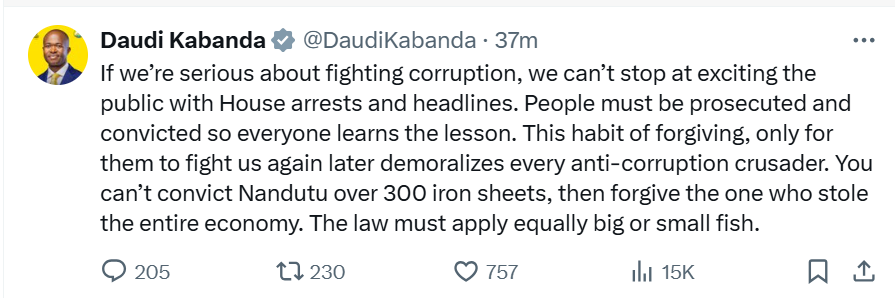
KAMPALA, Uganda — Ugandan legislator, Hon. Daudi Kabanda has called for stronger prosecution and conviction of individuals implicated in corruption cases, arguing that mere house arrests and publicized investigations alone are insufficient to deter graft.

In a post, Kabanda said anti-corruption efforts risk losing credibility when suspects are not ultimately convicted. He argued that the law should be applied equally regardless of a person’s political influence or social standing.
“If we’re serious about fighting corruption, we can’t stop at exciting the public with house arrests and headlines,” Kabanda wrote. “People must be prosecuted and convicted so everyone learns the lesson.”

Kabanda’s comments come amid ongoing public debate in Uganda over accountability in high-profile corruption cases involving public officials and the management of state resources. Anti-corruption campaigners have frequently criticized what they describe as selective enforcement and delays in the judicial process, while government officials have pointed to arrests, investigations and court proceedings as evidence of their commitment to fighting graft.
The lawmaker also referenced the case of former government minister, Agnes Nandutu, who was convicted in connection with the diversion of just 300 government iron sheets meant for vulnerable communities in northeastern Uganda but some people accused of larger-scale economic wrongdoing have avoided similar legal consequences. Though a name wasn’t mentioned, he mostly referred to a case of former Speaker, Rt. Hon. Anita Annet Among.
“The law must apply equally — big or small fish,” he wrote.
Uganda has long struggled with corruption allegations across multiple sectors of government. International watchdog groups and domestic civil society organizations have repeatedly called for stronger institutions, greater transparency in public spending and more consistent prosecution of corruption-related offenses.
Government officials have maintained that anti-corruption agencies are independent and that cases are handled according to available evidence and judicial procedures.
No part of this publication or its digital content may be reproduced, distributed, published, broadcast, rewritten, or redistributed in whole or in part without prior written permission from Kalisho Info.
For inquiries, contact: kalishoinfo@gmail.com
Stay informed and ahead of the curve! Follow Kalisho Info for real-time updates and breaking news.