
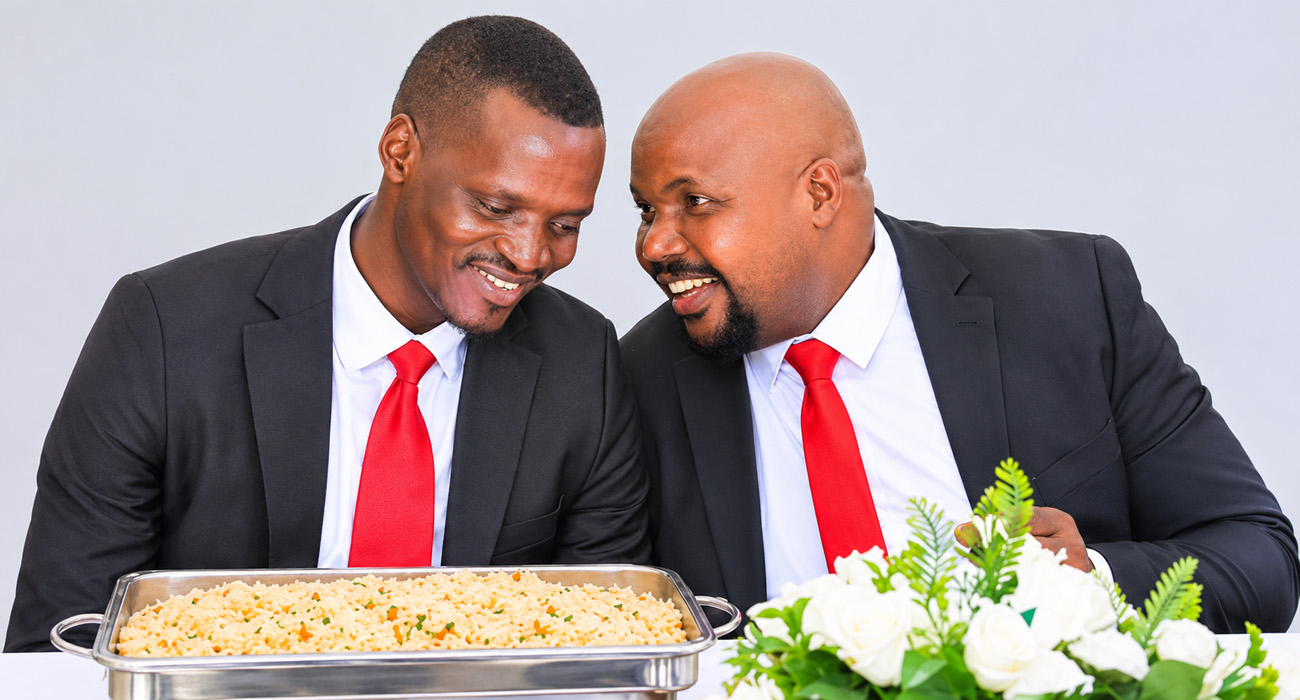
In July 2025, Mubarak Munyagwa and Moses Bigirwa sat around the same platter of food as they unveiled the Common Man’s Party (CMP). The gesture was intended to demonstrate unity, equality and the fair distribution of national resources.

Munyagwa became the party president, while Bigirwa assumed the position of secretary general. Together, they presented themselves as an alternative political force that would champion the interests of ordinary Ugandans.
Barely a year and a half later, that political marriage appears to have broken down. The two leaders are embroiled in a dispute that raises fundamental questions about the direction of Uganda’s multiparty democracy.
On Nov. 5, 2026, the CMP National Executive Committee indefinitely suspended Bigirwa over allegations of misconduct pending investigations. The decision followed disagreements over party administration, leadership responsibilities and the management of party headquarters.

Bigirwa had publicly questioned Munyagwa’s absence from party activities following the January 2026 general election. Munyagwa, on the other hand, defended the suspension as a decision made by the party’s executive committee rather than a personal decision.
What followed made the situation even more interesting. Bigirwa was named interim vice president of the National Peasants’ Party (NPP), despite the Electoral Commission still having him in its records as the secretary general of CMP.
In a letter dated Nov. 25, Electoral Commission Secretary Richard Baabo Kamugisha asked Bigirwa to clarify his party affiliation in writing. The commission maintained that a person should formally resign from one political party before joining another.
The issue, however, goes beyond what the Electoral Commission has in its records. It brings into question what political party membership actually means in Uganda.
Do politicians join political parties because they believe in their principles, or because those parties provide opportunities to occupy leadership positions?
There is absolutely nothing wrong with a politician leaving one political party for another. Political beliefs can evolve, disagreements can become irreconcilable, and every individual has the freedom to choose where they politically belong.
However, when a senior official is suspended from one political party and is named among the top leaders of another within weeks, the public is entitled to ask what informed that transition.
Did Bigirwa discover a stronger ideological connection with the National Peasants’ Party? Was there a fundamental difference between his political beliefs and those of CMP, or was the move simply a response to the leadership dispute?
These are legitimate questions, not accusations. Bigirwa deserves an opportunity to explain his position, just as CMP has a responsibility to handle his disciplinary proceedings fairly.
The National Peasants’ Party also deserves scrutiny. The appointment of senior leaders should ideally be informed by their commitment to the party’s values, their contribution to its development and the confidence that ordinary members have in them.
Political parties should not become convenient destinations for politicians who have fallen out with their colleagues elsewhere. Neither should leadership positions become consolation prizes for those who have lost influence in other political organisations.
Unfortunately, Uganda’s political conversation often revolves around personalities rather than institutions. We hear more about who has become president, who has been suspended and who has defected than we hear about the policies that distinguish one political party from another.
An ordinary Ugandan should be able to explain the difference between CMP and NPP beyond their names, symbols and leaders. What separates their economic policies? How differently would they address unemployment, corruption, education, health care and the rising cost of living?
Without clear ideological identities, political parties risk becoming interchangeable platforms for pursuing power. A politician can move from one to another without necessarily explaining any change in political conviction.
Munyagwa and his colleagues must also reflect on how they manage internal disagreements. A party that seeks to govern an entire country must demonstrate its ability to accommodate criticism, resolve disputes and administer justice within its own structures.
Uganda does not necessarily need more political parties. It needs stronger political institutions that can survive disagreements, leadership changes and electoral defeats without losing their purpose.
The ultimate question is not whether Bigirwa remains secretary general of CMP or becomes vice president of NPP. It is whether the ordinary Ugandan, in whose name these political organisations seek power, stands to benefit from such political movements.
Leadership positions are temporary. Political principles should outlive them.
Until Uganda’s political parties become institutions built around ideas rather than individuals, disagreements between politicians will continue to attract more attention than the problems those politicians promise to solve.
No part of this publication or its digital content may be reproduced, distributed, published, broadcast, rewritten, or redistributed in whole or in part without prior written permission from Kalisho Info.
For inquiries, contact: kalishoinfo@gmail.com
Stay informed and ahead of the curve! Follow Kalisho Info for real-time updates and breaking news.