
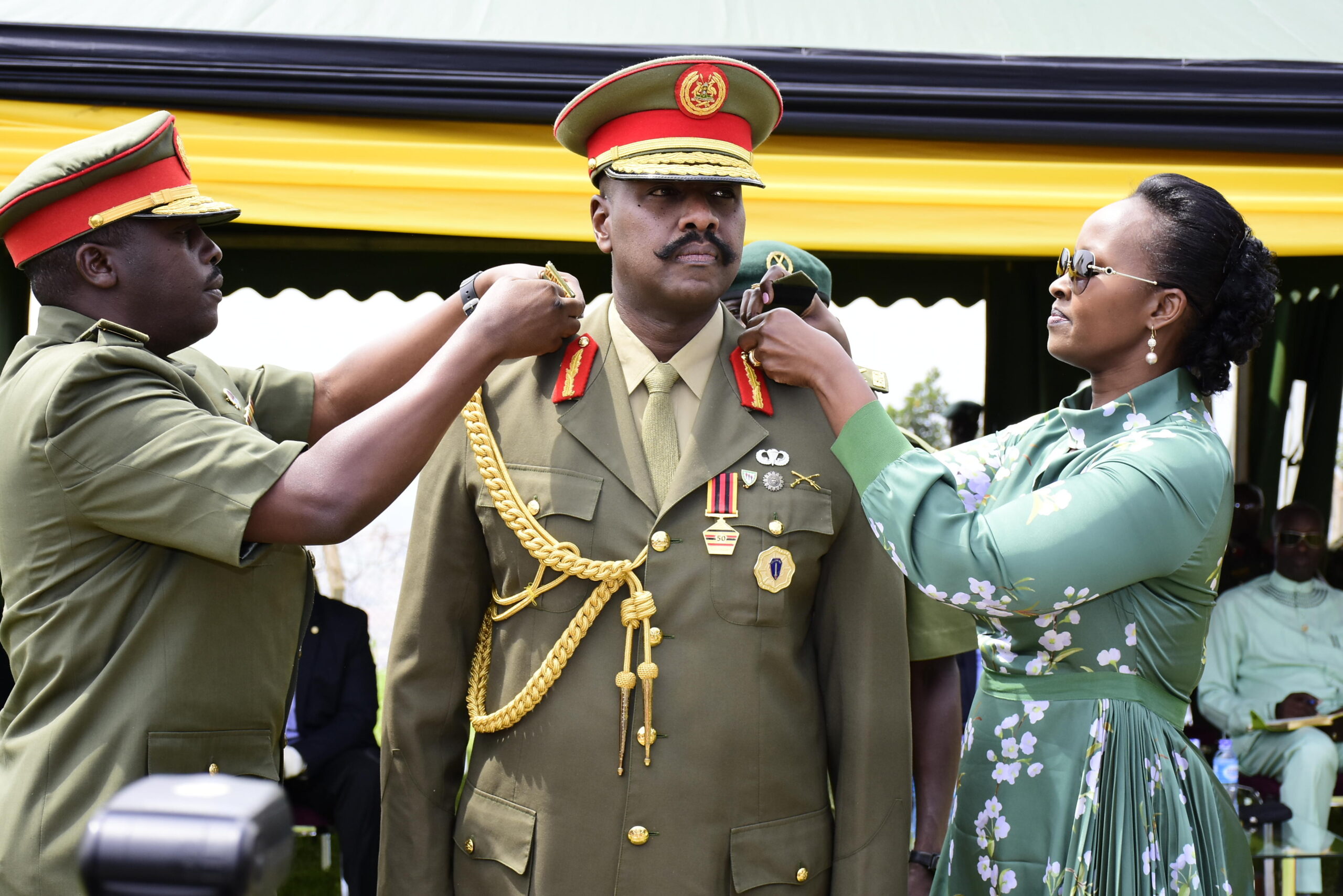
On March 21, 2024, Gen. Muhoozi Kainerugaba was named chief of the Uganda Peoples’ Defence Forces. Since then, his X account has become a flashpoint in debates over the line between personal expression and official duty.

The CDF is known for outspoken posts on military affairs, politics and national issues. His comments have often drawn attention in Uganda and beyond.
This raises a key question: Are Muhoozi’s tweets simply personal views, or can they be treated as official communication from Uganda’s top military officer? The answer lies in a gray area involving law, military practice and the growing role of social media.
X is clearly a platform for public expression. It allows public figures to share their views instantly with large audiences.

For Muhoozi, the reach is greater because of his position as CDF and his status as the son of President Yoweri Museveni. His X handle, @mkainerugaba, has a significant following, giving his posts an audience far beyond that of an ordinary social media user.
But public communication is not the same as official policy. In Uganda, military directives generally move through established channels such as official orders, statements and briefings.
X has no clearly defined place in that system. This means Muhoozi’s posts can be influential without automatically carrying official or legal authority.
The question becomes more complicated when considering whether his tweets can bind him as CDF. For a tweet to have such force, it would need to amount to an official order or commit the UPDF to a specific action or policy.
Uganda’s Constitution provides some guidance. Article 208 establishes the UPDF to preserve and defend the country’s sovereignty and territorial integrity, while Article 209 sets out its functions.
Neither provision identifies social media as an official channel for military orders. The Uganda Peoples’ Defence Forces Act, 2005, also does not specifically address platforms such as X.
Section 43 of the UPDF Act regulates the conduct of officers and prohibits actions that undermine discipline or good order. It does not, however, state that a CDF’s social media posts automatically constitute military orders.
Events in 2022 offer an example. In October that year, Muhoozi posted that it would not take “my army and me” two weeks to capture Nairobi, triggering a diplomatic uproar.
The Ugandan government quickly clarified that the comments did not represent UPDF policy. The incident showed that even provocative comments from the CDF do not automatically become military policy.
The response also created a practical precedent. Muhoozi’s X posts could be treated as personal unless they were formally adopted by the state, although that precedent is not written into law.
The Computer Misuse Act, 2011, as amended in 2022, regulates online conduct. It includes provisions on malicious information and hateful content, with some offenses carrying penalties of up to seven years in prison.
Whether those provisions could apply to a CDF because of a controversial tweet remains untested in this context. Any such case would raise questions about how the law applies to a senior military officer.
The Regulation of Interception of Communications Act, 2010, adds another layer. Section 4 allows security agencies to monitor communications in certain circumstances involving national security.
That does not make a monitored tweet an official military communication. Monitoring and authorization are separate issues.
The Public Order Management Act, 2013, also regulates public statements and activities that could contribute to public disorder. Its framework has largely focused on public gatherings rather than statements posted online.
Uganda’s legal framework therefore treats social media mainly as a space for expression. It does not clearly establish it as a formal channel of military command.
In practice, however, Muhoozi’s position makes the distinction less clear. As CDF, his words carry more weight than those of an ordinary social media user.
A post praising the military could be viewed as an effort to boost morale. A post attacking critics could instead be seen as personal commentary, and sometimes the two may overlap.
The 2022 Kenya episode demonstrated this duality. Kenya sought explanations and Uganda distanced itself from the remarks, but the posts still affected perceptions of Muhoozi’s influence.
That influence is not necessarily legal authority. It is a form of soft power that can shape public opinion and create concern in neighboring countries.
The government’s social media guidelines, issued by the Ministry of ICT in 2016, encourage officials to avoid misinformation and exercise caution online. However, they do not clearly explain how posts by senior military commanders should be treated.
The UPDF’s January 2024 directive on social media conduct also emphasizes discipline. It does not establish that every post by a senior officer is an official military communication.
So where does this leave Muhoozi’s tweets? They are clearly public communication, but that does not automatically make them binding military orders.
Under current law and practice, his posts are not automatically binding on the UPDF unless they are presented and recognized as official orders. That distinction becomes harder to maintain when the person posting is the country’s top military commander.
The ambiguity presents a problem in the digital age. A single post can create a diplomatic crisis before government officials have time to explain whether it represents official policy.
The 2022 Kenya episode was resolved through a government clarification. A future incident could be more difficult if events moved faster than the government’s response.
Muhoozi’s use of X therefore exposes a gap between laws that regulate online conduct and the responsibilities attached to senior military positions. The laws govern behavior, but they do not clearly define when a senior officer’s social media post becomes an official communication.
The issue also touches on freedom of expression, military discipline and Uganda’s national image. Article 29 of the Constitution protects freedom of expression, while military service carries obligations of discipline and restraint.
The Computer Misuse Act places limits on online conduct. At the same time, critics have questioned whether powerful figures face the same scrutiny as ordinary citizens, including opposition supporters who have been prosecuted over social media posts.
That debate is likely to continue. Until Uganda develops clearer rules, perhaps through a specific UPDF social media policy, Muhoozi’s posts will remain in an uncertain space.
His statements can be personal views while still carrying the weight of his military position. His posts may not deploy tanks, but they can shape public opinion, influence debate and create diplomatic problems.
The central question remains unresolved: Are these the views of a man who commands the military, or communications from the military commander? Without a clear answer, every controversial tweet leaves room for another dispute over where personal expression ends and military authority begins.
No part of this publication or its digital content may be reproduced, distributed, published, broadcast, rewritten, or redistributed in whole or in part without prior written permission from Kalisho Info.
For inquiries, contact: kalishoinfo@gmail.com
Stay informed and ahead of the curve! Follow Kalisho Info for real-time updates and breaking news.