
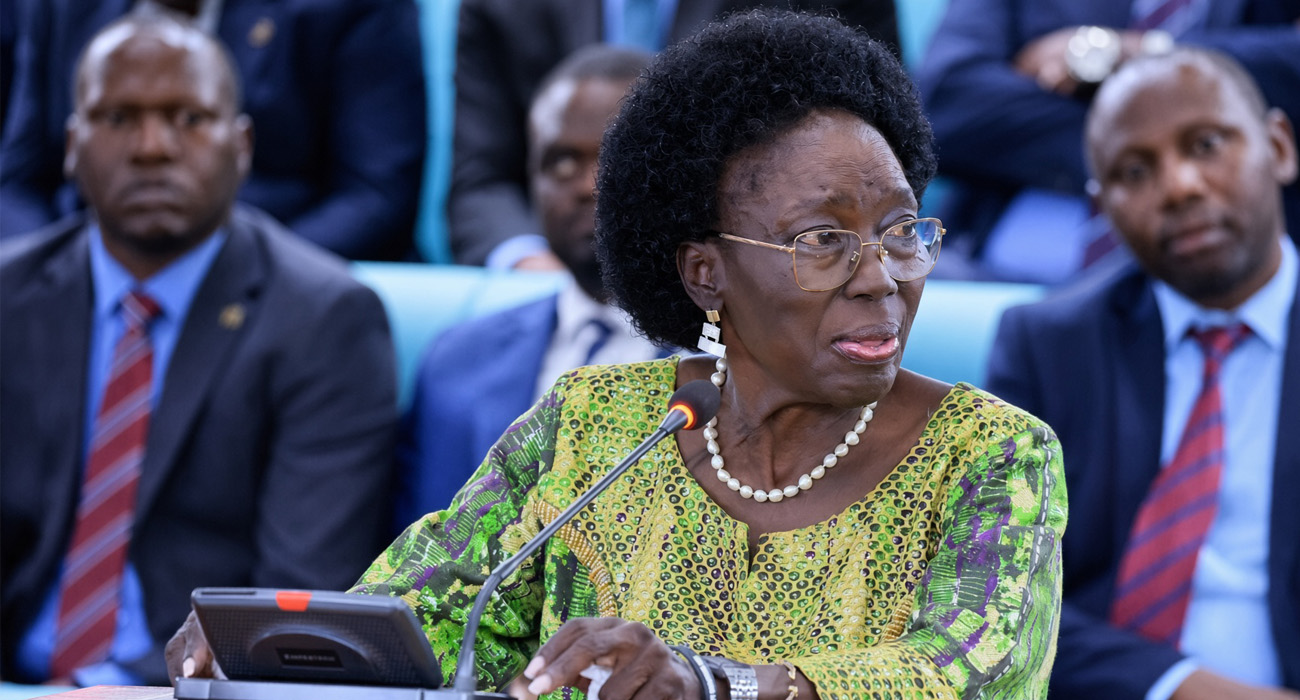
PARLIAMENT, Uganda – First Deputy Prime Minister and Minister of East African Community Affairs, Rt. Hon. Rebecca Kadaga has briefed Parliament on progress towards establishing an integrated regional payment system aimed at making cross-border transactions faster, cheaper and more accessible across East Africa.

Presenting a statement to Parliament on Tuesday, November 3, 2026, Kadaga outlined the status of the East African Community (EAC) payment systems and the implementation of the regional Cross-Border Payment System Masterplan.
The initiative seeks to establish an integrated payment and settlement infrastructure that supports regional trade, investment and the movement of capital among EAC Partner States.
At the centre of the existing arrangements is the East African Payment System (EAPS), which connects the national Real-Time Gross Settlement (RTGS) systems of Uganda, Kenya, Tanzania and Rwanda.

The platform enables commercial banks in participating countries to transfer funds across borders and settle transactions in their respective local currencies rather than relying primarily on the US dollar.
These currencies include the Uganda shilling, Kenya shilling, Tanzania shilling and Rwanda franc.
Under the arrangement, a transaction moves from a customer’s bank through the national RTGS system, across the EAPS platform and into the receiving country’s payment system. Once completed, settlement is final and irrevocable.
Kadaga said the system offers several benefits to Uganda, including faster and more secure cross-border transactions, reduced correspondent banking costs and greater certainty for businesses involved in regional trade.
It is also expected to support regional value chains and advance the EAC’s ambition of establishing a monetary union.
However, regional payment integration remains incomplete. Burundi, South Sudan, the Democratic Republic of Congo and Somalia are yet to achieve full integration into the system.
Cross-border mobile money and retail payment services also remain fragmented, while businesses continue to face high transaction charges, foreign exchange costs, limited awareness and differences in national regulations.
To address these challenges, the EAC adopted the Cross-Border Payment System Masterplan in 2025. The framework was approved during the 28th Ordinary Meeting of the EAC Monetary Affairs Committee held on May 9, 2025, in Mombasa, Kenya.
The Masterplan is organised around four strategic pillars: Governance, Legal, Regulatory and Oversight; Infrastructure; Inclusivity; and Capacity Building.
It contains 20 strategic initiatives designed to modernise the existing EAPS, establish a regional instant retail payment switch and connect bank accounts, mobile money wallets and fintech platforms across Partner States.
The framework also seeks to harmonise licensing and regulatory requirements while expanding access to payment services for micro, small and medium enterprises (MSMEs) and informal cross-border traders.
Its implementation roadmap is divided into three phases. The short-term phase, covering one to two years, focuses on regulatory harmonisation, basic infrastructure improvements and capacity building.
The medium-term phase, covering three to five years, targets greater interoperability and the operationalisation of a regional instant retail payment switch. Longer-term efforts will focus on deepening regional integration and connecting East African payment networks to international systems.
According to the statement, implementation has progressed beyond the planning stage, with several institutional milestones recorded in 2026.
These include a knowledge exchange programme on payment system interoperability in Europe in March and the inauguration of three Technical Working Groups in Mombasa in August.
The groups are responsible for advancing work on monitoring and reporting, cooperative oversight and mutual recognition of payment service providers across the region.
However, the establishment of these working groups does not mean the proposed regional instant payment switch is already operational. Considerable technical, regulatory and institutional work remains.
For Uganda, successful implementation will require cooperation among the Bank of Uganda, the Ministry of Finance, the Ministry of East African Community Affairs, commercial banks, mobile network operators and fintech companies.
Parliament also has a role in supporting the alignment of national laws with EAC frameworks, providing for digital and financial infrastructure, strengthening cybersecurity and consumer protection oversight, and monitoring Uganda’s fulfilment of regional commitments.
Kadaga said a fully integrated payment and settlement system would lower the cost of doing business, increase intra-EAC trade and encourage the use of Partner States’ currencies in regional transactions.
The initiative is also expected to provide an important foundation for the proposed East African Monetary Union and the eventual introduction of a single regional currency.
The long-term objective is to enable individuals and businesses to transfer money securely, quickly and affordably between any two EAC Partner States through bank accounts, mobile money wallets and other authorised digital payment channels.
No part of this publication or its digital content may be reproduced, distributed, published, broadcast, rewritten, or redistributed in whole or in part without prior written permission from Kalisho Info.
For inquiries, contact: kalishoinfo@gmail.com
Stay informed and ahead of the curve! Follow Kalisho Info for real-time updates and breaking news.