
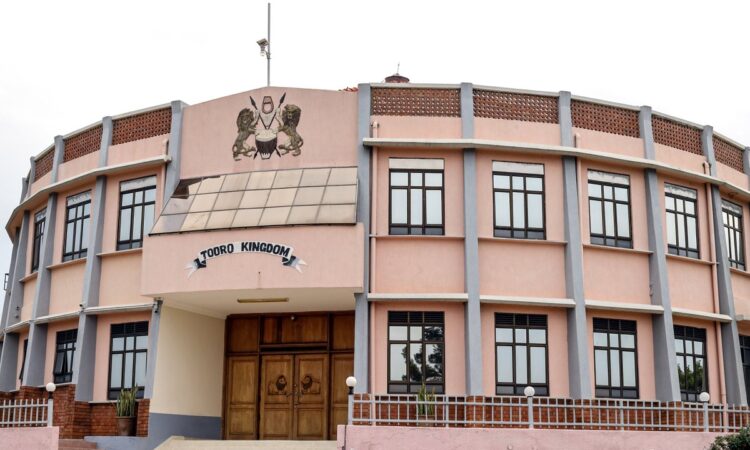
The Tooro Kingdom, or Obukama bwa Tooro, is one of Uganda’s recognised traditional institutions. Its people, the Batooro, speak Rutooro and share deep cultural ties with neighbouring Bunyoro through the ancient Kitara heritage of the Batembuzi, Bachwezi and Babiito dynasties. Today, the kingdom functions as a cultural institution rather than a political power, centred on Fort Portal and extending across Kabarole, Bunyangabu, Kamwenge, Kitagwenda, Kyenjojo, Kyegegwa and Ntoroko.
- The Founder and the First Turbulent Decades
- Restoration Under the British
- The Long Reign of Rukidi III
- A King Who Reigned for Only Two Years
- The Boy King
- A Kingdom Again at a Succession Crossroads
- Karuzika and the Symbols of the Monarchy
- Amabere ga Nyina Mwiru and the Older Royal Story
- A Monarchy Shaped by Survival

The kingdom is currently in mourning following the death of Omukama Oyo Nyimba Kabamba Iguru Rukidi IV on Aug. 27, 2026, at the age of 34. Oyo had spent 31 years on the throne after being enthroned at the age of three. His death has once again placed succession at the centre of public attention, as the Babiito royal family prepares to identify and present his successor according to tradition.
The story of Tooro is, above all, a story of its kings. It is also a story of power struggles, disputed successions, remarkably short reigns, exile, foreign intervention and the resilience of a royal institution that has survived profound political change.
The Founder and the First Turbulent Decades
Tooro emerged as an independent kingdom around 1830, although some royal traditions place its establishment closer to 1822. Prince Kaboyo Olimi I, whose full name was Rukirabasaija Omukama Kaboyo Omuhundwa Kasusunkwanzi Olimi I, broke away from his father, Omukama Nyamutukura Kyebambe III of Bunyoro Kitara.

Kaboyo took control of the fertile southern provinces and established his own court, creating the foundation of the Tooro Kingdom. He ruled for about three decades before his death and was buried near Kibiito.
The stability of his reign did not last.
After Kaboyo’s death, Tooro entered one of the most turbulent periods in its history. Brothers and princes competed for the throne, with several rulers holding power for only months or a few years.
The early rulers included Ruhaga, also known as Kazana Ruhaga I, who ruled from 1865 to 1866 before being overthrown or killed by his brother. Nyaika Kasunga Kyebambe I ruled in two periods between 1866 and 1872. Kato Rukidi I followed around 1871 or 1872, while Olimi II, also known as Mukabirere, ruled from 1872 to 1875.
Rukidi II had a brief reign in 1875. Rububi Kyebambe II also ruled in two periods, while Kakende Nyamuyonjo held the throne in two spells before his reign ended in 1880. Katera ruled from 1876 to 1877.
The succession disputes were not simply matters of royal ceremony. They involved struggles for control of the kingdom and its resources and were increasingly complicated by the expansion of neighbouring Bunyoro.
By 1880, Tooro had been reconquered and absorbed back into Bunyoro under Omukama Kabalega. The kingdom entered an interregnum that lasted until 1891. Members of the Tooro royal family fled into exile in Ankole and Buganda, while others were killed.
For more than a decade, the independent Tooro monarchy effectively disappeared.
Restoration Under the British
The modern Tooro Kingdom emerged in 1891 through British intervention.
Captain Frederick Lugard of the Imperial British East Africa Company, seeking allies against Kabalega, installed the young Daudi Kasagama as Omukama. Kasagama, a descendant of the royal line who had grown up in exile, was proclaimed king near Lake Katwe and later at Kabarole.
He took the throne name Kyebambe IV, although historical records sometimes number him differently in the Tooro succession.
Kasagama entered into agreements with the British and converted to Anglican Christianity in 1896, taking the baptismal name Daudi, or David. He welcomed missionaries and supported the development of early schools.
His reign also helped redefine Tooro’s political position under British colonial rule. The kingdom became part of the colonial system of indirect rule, with the Omukama retaining a degree of traditional authority under British oversight.
Unlike the short and contested reigns that had preceded him, Kasagama ruled for nearly four decades, from 1891 until 1928. His long reign brought relative stability to a kingdom that had experienced years of conflict and political uncertainty.
He died in late 1928 and was buried at Karambi.
The Long Reign of Rukidi III
Kasagama was succeeded by his son, Sir George David Matthew Kamurasi Rukidi III, who was born in 1904. He became Omukama in 1928 or 1929 and remained on the throne until December 1965.
Rukidi III was educated at King’s College Budo and served in the King’s African Rifles and the Uganda Police. He was knighted by Queen Elizabeth II in 1962 and attended her coronation.
His 37 year reign became one of the longest and most stable periods in the history of the Tooro monarchy.
Rukidi III founded the Orukurato Orukuru, the kingdom’s supreme council, and promoted education, including scholarships. His reign also coincided with growing interest in mineral development and the transformation of Tooro society under colonial rule and, later, independence.
His death in 1965 marked another major turning point.
A King Who Reigned for Only Two Years
Patrick David Matthew Kaboyo Olimi III succeeded his father in 1965.
His reign lasted only two years.
In 1967, President Milton Obote abolished Uganda’s traditional kingdoms, bringing the Tooro monarchy to an abrupt end. Olimi III was forced into exile and later served Uganda as a diplomat in Tanzania and ambassador to Cuba.
For nearly three decades, Tooro existed without a reigning Omukama.
The institution survived largely through cultural identity, family structures and the continued attachment of the Batooro to their royal heritage.
When President Yoweri Museveni restored Uganda’s traditional kingdoms as cultural institutions in 1993, Olimi III returned and was reinstated as Omukama.
He died on Aug. 26, 1995, aged 50.
The Boy King
Less than three weeks after Olimi III’s death, Tooro received another young king.
On Sept. 12, 1995, three year old Oyo Nyimba Kabamba Iguru Rukidi IV was enthroned following traditional rituals that included a mock battle and a test of royal blood.
Oyo became one of the world’s youngest reigning monarchs, a distinction later recognised by Guinness World Records.
Because of his age, regents handled the affairs of the kingdom until he became an adult. Oyo was educated in Uganda and later earned a business degree from the University of Winchester in the United Kingdom.
On April 17, 2010, he assumed full royal duties.
Unlike some of his predecessors, Oyo enjoyed a long and largely stable reign. For 31 years, he became the public face of a restored Tooro monarchy that operated within the limits of Uganda’s constitutional system.
His reign focused heavily on youth programmes, HIV and AIDS awareness, environmental conservation, education and cultural tourism. He also served as a UNAIDS cultural champion.
Oyo maintained close relations with the Ugandan government and participated in efforts to recover some kingdom properties through negotiations with the central government.
His reign ended with his death in the United States on Aug. 27, 2026, after a period of illness.
He was 34.
A Kingdom Again at a Succession Crossroads
Oyo’s death has brought Tooro back to a familiar moment in its history: succession.
For much of the kingdom’s early history, the question of who would occupy the throne was closely linked to struggles within the royal family. Some kings ruled for decades, while others lasted only months. Some were overthrown or killed, while others were forced into exile.
The abolition of the kingdoms in 1967 introduced a different kind of interruption, removing the monarchy altogether for almost three decades.
The restoration in 1993 brought the institution back, but as a cultural body rather than a political government.
Oyo’s 31 year reign represented the longest continuous period of royal stability since the reigns of Kasagama and Rukidi III.
His death therefore closes one of the most stable chapters in modern Tooro history and opens another succession process whose outcome will determine the next chapter of the monarchy.
A prince has been identified as heir, but the identity is expected to be formally revealed according to Babiito tradition.
Queen Mother Best Kemigisa and Princess Ruth Komuntale survive Oyo.
Karuzika and the Symbols of the Monarchy
The Karuzika Palace remains the symbolic centre of the Tooro monarchy and a key representation of the kingdom’s restored institution.
The current palace was constructed with support from former Libyan leader Muammar Gaddafi following the restoration of traditional kingdoms in Uganda.
But the history of Tooro cannot be contained within a palace.
Across the kingdom are places and traditions that connect the present monarchy to a much older past.
Amabere ga Nyina Mwiru and the Older Royal Story
About 10 kilometres from Fort Portal are the Amabere ga Nyina Mwiru caves, also known as the Nyakasura Caves.
The name means “the breasts of Nyina Mwiru.” Stalactites at the site produce a milky calcium carbonate solution that local tradition has long associated with breast milk.
The caves are both a geological formation and a site of oral history shared by Tooro and Bunyoro.
According to tradition, Nyinamwiru, the beautiful daughter of King Bukuku, was linked to the late Batembuzi or early Bachwezi period, centuries before the establishment of the modern Tooro Kingdom.
One version of the story says Bukuku received a prophecy that his daughter’s son would overthrow him. He responded by mutilating her and preventing her from marrying or nursing a child.
Another version says she rejected an arranged marriage.
She eventually conceived and gave birth to Ndahura. Unable to breastfeed him, tradition says she nourished him with the dripping “milk” from the rocks.
Ndahura later fulfilled the prophecy and became a great king, founding or restoring the Bachwezi line from which the later Babiito dynasties of Bunyoro and Tooro trace their heritage.
The formations themselves are ordinary limestone stalactites and stalagmites formed over thousands of years. But culturally, they remain an important part of the region’s heritage and a major tourist attraction.
A Monarchy Shaped by Survival
The history of Tooro is therefore not simply a succession of kings.
It is a history of a royal family that broke away from Bunyoro, fought among itself for control of the throne, lost the kingdom to Bunyoro, sent its princes into exile, regained the throne through British intervention, survived the abolition of traditional institutions and eventually returned to the public stage.
Its kings have reflected those different chapters.
Kaboyo Olimi I represents the birth of an independent Tooro. The short reigns that followed reveal the fierce struggles over succession that once shaped the kingdom. Kasagama represents restoration under colonial power and the beginning of a long period of stability. Rukidi III represents continuity and institutional development.
Olimi III represents the disruption of the monarchy, exile and eventual return.
Oyo represents restoration in a new era, having inherited the throne as a child and grown into one of Uganda’s most recognisable traditional leaders.
Now, following his death at 34, Tooro once again stands before a royal succession.
The next Omukama will inherit not only a throne but two centuries of history marked by rebellion, rivalry, short reigns, exile, restoration and survival.
Whatever comes next, the story of Tooro will continue to be told through the kings who have occupied its throne and the people who have preserved the institution through generations of political change.
No part of this publication or its digital content may be reproduced, distributed, published, broadcast, rewritten, or redistributed in whole or in part without prior written permission from Kalisho Info.
For inquiries, contact: kalishoinfo@gmail.com
Stay informed and ahead of the curve! Follow Kalisho Info for real-time updates and breaking news.