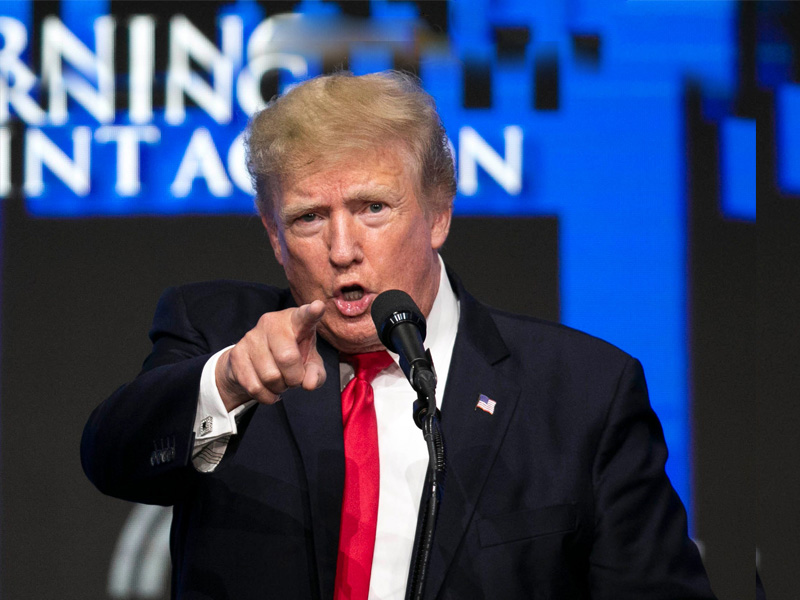

WASHINGTON — US President Donald Trump is facing a difficult political test after Democrats made significant gains in the November 3 midterm elections, winning control of the House of Representatives and overturning several Republican-held seats in contests that could reshape the final two years of his presidency.

The results represent a major setback for Trump and the Republican Party, which entered the elections controlling both chambers of Congress. Although Trump was not on the ballot, the elections were widely viewed as a public assessment of his leadership, economic policies and handling of major national issues.
The Democratic Party’s projected takeover of the House means Trump will have to contend with a Congress in which the opposition controls one of the most powerful institutions in the American political system. By the time of this article, the Democrats had secured the 218 seats required for a House majority, taking control from Republicans.
The change has significant implications for the president. The House of Representatives plays a central role in passing federal legislation, approving government spending and overseeing the executive branch. With Democrats in control, Trump’s administration will find it harder to push through its legislative priorities without negotiating with the opposition.

Democratic lawmakers will also gain control of House committees, giving them greater authority to investigate government activities, summon officials to testify and scrutinise decisions made by the administration. This could bring renewed congressional investigations into Trump’s policies, appointments and executive actions.
A divided Congress does not automatically stop a president from governing. Trump retains executive powers, and Republicans still have influence in the Senate. However, legislation requiring congressional approval could face significant resistance, while disputes over government funding and national priorities may become more difficult to resolve.
The setback extends beyond the House. Democrats have also been projected to win control of the Senate, giving the party control of both chambers of Congress for the remainder of Trump’s presidency. The Democrats had secured the 51 seats needed for a Senate majority, against at least 39 projected Republican seats, with other races still awaiting final calls.
This is particularly damaging for Trump because Republicans had entered the election with a 53 to 47 Senate advantage, including independents who caucused with Democrats. Losing the Senate means the president will face opposition not only when seeking to pass laws but also when making important appointments that require Senate confirmation, including federal judges and senior government officials.
The Democratic victory also gives the party control of congressional committees in both chambers. This will allow lawmakers to conduct investigations, issue subpoenas and demand explanations from government officials. Potential areas of scrutiny include the administration’s economic decisions, foreign policy, immigration enforcement and the use of executive powers.
The election has also exposed the political vulnerability of several Republican strongholds, with Democrats recording victories in states that have traditionally favoured the Republican Party.
In Texas, Democrat James Talarico defeated Republican Ken Paxton in the Senate race, delivering one of the biggest surprises of the night. Texas has not elected a Democratic senator since 1988, making the victory a major political breakthrough for the party.
Democrats also won the Texas governor’s race, with Gina Hinojosa defeating Republican incumbent Greg Abbott. Her victory makes her the first Latina elected governor of Texas, a state that has remained under Republican control for decades.
Kansas also produced a historic result. Democrat Adam Hamilton defeated Republican incumbent Roger Marshall, becoming the first Democrat elected to represent the state in the US Senate since 1932. The outcome is particularly significant because Kansas has consistently voted Republican in recent presidential elections and supported Trump by a substantial margin.
In South Carolina, Democrat Annie Andrews defeated Republican Darline Graham, flipping another Republican-held Senate seat. The state had not elected a Democratic senator since 1998. Andrews’ victory was another indication that the Democratic gains were not confined to traditionally competitive states.
Ohio delivered another major surprise when Democrat Sherrod Brown defeated Republican incumbent Jon Husted to reclaim a Senate seat. Brown had previously represented Ohio in the Senate before losing his re-election bid in 2024.
In North Carolina, Democrat Roy Cooper defeated Republican Michael Whatley, flipping a seat that had been held by Republicans. Democrats also secured victories in New Hampshire and retained Georgia’s Senate seat, where Jon Ossoff defeated Republican challenger Mike Collins.
These victories helped Democrats reach the 51-seat threshold needed to take control of the Senate, a result that significantly changes the balance of power in Washington.
One of the most significant victories came in Georgia, where Democrat Keisha Lance Bottoms defeated Republican businessman Rick Jackson to become the first Black woman elected governor of a US state. She will also become Georgia’s first female governor.
Bottoms, 56, previously served as mayor of Atlanta and later worked as a senior adviser to former President Joe Biden. Her victory ends more than two decades of Republican control of Georgia’s governor’s office, which has been held by Republicans since 2003.
The result is historic because, despite the long-standing influence of Black women in American politics, no Black woman had previously been elected governor of a US state. Her election marks a major milestone in the country’s political representation. Axios+2
Georgia was not the only state to record a historic breakthrough. Democrat David Crowley won the Wisconsin governor’s race, becoming the state’s first Black governor. In New Mexico, Democrat Deb Haaland made history as the first female Native American elected governor of a US state. She previously served as US Interior Secretary under Biden.
Texas also made history with Hinojosa’s election as its first Latina governor. Meanwhile, Democratic House leader Hakeem Jeffries won re-election to Congress and is positioned to become the first Black speaker of the House of Representatives if elected by the new Democratic majority. The Guardian+1
Another notable result came in Ohio’s governor’s race, where Democrat Amy Acton defeated Republican Vivek Ramaswamy, the former presidential candidate and technology entrepreneur. Ramaswamy’s defeat was another setback for Republicans in a state that has increasingly leaned towards the party in recent national elections.
In Florida, however, Republicans secured a significant victory when Byron Donalds won the governor’s race, defeating his Democratic challenger. Republican Senator Ashley Moody also retained her Senate seat, demonstrating that the Democratic gains were not universal. The Guardian+1
The election results have been linked to growing dissatisfaction with the cost of living, economic conditions and Trump’s leadership. Pre-election polling had shown that the president was struggling with approval ratings, while voters identified the economy as one of their leading concerns.
According to figures reported by TIME ahead of the election, Trump’s approval rating had fallen to 30% in an early October Pew Research Center survey. An Associated Press-NORC poll also found that only about 26% of adults approved of his handling of the economy.
The economic concerns are politically significant because Trump returned to the White House promising to reduce living costs and improve the financial position of American households. The election results suggest that a section of voters remains dissatisfied with the administration’s performance on those promises. TIME+1
Trump has responded to the Republican losses by distancing himself from the election outcome. In a message published on his Truth Social platform, he argued that Republicans would have won overwhelmingly had he been on the ballot.
“I wasn’t on the Ballot and if I was, we would have won IN A LANDSLIDE!” he wrote.
However, his involvement in the campaigns had been substantial. He endorsed candidates, attended rallies and encouraged voters to treat the elections as a decision on whether his administration should continue receiving congressional support.
In an interview with The New York Times, Trump subsequently said he was willing to accept the results and work with the opposition party.
For Republicans, the outcome is likely to trigger difficult questions about the party’s political direction, its relationship with Trump and the strategy it should adopt ahead of the 2028 presidential election. Some Republican figures have already blamed the president’s low approval ratings and unpopular policies for the defeats.
The results also give Democrats an opportunity to rebuild their political position after losing the 2024 presidential election and surrendering control of the Senate. Their performance in traditionally Republican states suggests that they may have found an effective message around economic concerns and dissatisfaction with the federal government.
For Trump, the immediate challenge will be governing without congressional control. His administration will have to negotiate with Democratic lawmakers on legislation, government spending and other national priorities. Even proposals supported by Republicans could face difficulties if Democrats oppose them.
The new Congress is expected to begin work in January 2027, giving the president and his political opponents a little over two years to navigate an increasingly divided political environment before Americans return to the polls for the next presidential election.
The 2026 midterms have therefore delivered more than a change in congressional leadership. They have produced historic political firsts, overturned long-standing party loyalties in several states and given Democrats a stronger position from which to challenge Trump’s second-term agenda.
For a president who entered the election with both chambers of Congress behind him, the result represents a major political warning.
No part of this publication or its digital content may be reproduced, distributed, published, broadcast, rewritten, or redistributed in whole or in part without prior written permission from Kalisho Info.
For inquiries, contact: kalishoinfo@gmail.com
Stay informed and ahead of the curve! Follow Kalisho Info for real-time updates and breaking news.