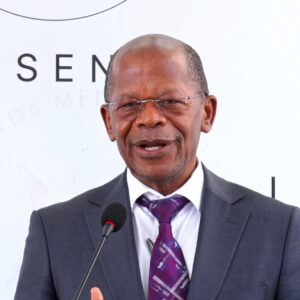

KAMPALA, Uganda — Attorney General Dr. Sam Mayanja has advised President Yoweri Museveni that the last will of the late Omukama Oyo Nyimba Kabamba Iguru Rukidi IV should be the prime guide in determining who succeeds him as king of Tooro, saying any challenge to the will’s validity can only be settled by a court of law.
In a legal opinion dated Sept. 12, 2026 to the President, Mayanja said that Oyo’s will should remain the starting point in identifying his successor.
“King Oyo’s will should be followed. Its validity can only be challenged in the courts of law,” Mayanja wrote, according to the opinion.
A 21 member Babiito Royal Succession Committee elected Edward Rukidi Kijanangoma with now the name, Edward Rukiidi Nyabongo I, as the new claimant to the throne. Oyo’s immediate family has rejected the process and insists that the late king left a written succession plan.

Mayanja said there is a live dispute over both the contents and validity of Oyo’s will. He noted that the council of elders had failed to resolve the matter to the satisfaction of the community and all interested parties.
In such circumstances, he said, the dispute can ultimately only be resolved by a court.
The Attorney General based his opinion on Article 246 of the Constitution of Uganda and the Institution of Traditional or Cultural Leaders Act, which provide for traditional institutions to operate in accordance with the culture, customs and traditions of their communities.

He also pointed to birth and descent as important considerations in determining allegiance to a traditional leader.
According to Mayanja’s interpretation of Oyo’s will, the late king directed that if he was survived by a lawfully recognised biological son, that son would inherit the Tooro throne.
“I hereby declare and direct that if at the date of my death I am survived by a son, lawfully recognised as my biological son, I appoint him as my heir to the kingdom of Tooro,” the document states, according to the Attorney General’s opinion.
If no such son could succeed, the will provided for alternative heirs. Among those named was Prince Komwiswa Yoweri, a son of Omusuunga Charles Kamurasi. Prince Solomon Nyaika was also reportedly listed among the alternatives.
However, the succession debate has raised another question within the royal family: whether sons of a reigning Omusuunga can themselves become Omukamas while their father is still alive.
Some voices within Tooro argue that Omusuunga Charles Kamurasi’s sons, who are cousins of the late King Oyo, cannot take the throne while their father remains alive. In this view, it would be difficult for a son to assume the kingship while his own father, who is also a senior member of the royal hierarchy, is still living.
Those advancing this view argue that the question should be considered alongside the order of succession set out in Oyo’s will and the customs of the Babiito royal family. It is, however, a position within the wider succession dispute and not a determination already made by a Ugandan court.
The succession committee has said it asked Oyo’s family to produce the alleged son or provide a photograph and received neither. It subsequently selected Nyabongo from the Kijanangoma line.
The committee had earlier considered George Desmond Kamurasi but he reportedly asked for more time to consult his family. The request was not granted, after which the committee proceeded with another candidate.
Oyo’s closest relatives have rejected that process and continued to point to the late king’s will.
Mayanja also addressed the status of the 1999 Tooro Kingdom Constitution, which has become another point of contention in the succession debate.
The Attorney General said the constitution cannot currently provide the immediate legal basis for the succession because Oyo suspended it in 2013. A committee established to review it did not complete its work before his death.
Mayanja also referred to the High Court decision in George Kusemererva v. King Oyo, which upheld the suspension.
“As such the Constitution remains suspended,” the Attorney General said.
This leaves Oyo’s will, customary law and the applicable national legal framework at the center of the current dispute.
But while the Attorney General’s opinion carries considerable legal weight, it should not be confused with a court order or a binding judgment.
Under Uganda’s constitutional system, the Attorney General is the principal legal adviser to government. His role is to give legal advice, not to replace the courts in determining contested legal questions.
Ugandan courts have previously made this distinction clear.
In Kabagambe Asol and Others v Electoral Commission and Another, decided by the Constitutional Court in 2006, the court held that the Attorney General’s advice does not automatically amount to a directive that must be obeyed. The case concerned advice given to the Electoral Commission, an institution that the Constitution guarantees independence.
The court said the Electoral Commission could receive the advice, consider it and reject it.
A similar position was discussed in Saleh Kamba and Another v Attorney General and Others in 2014. The Constitutional Court said Attorney General’s advice should be accorded the highest respect by public institutions, but also distinguished legal advice from a command.
A practical example came in the 2006 presidential nomination dispute involving the Electoral Commission. Despite the Attorney General’s position, the Commission took its own decision on whether a presidential candidate could be nominated in absentia. The matter eventually went before the Constitutional Court in Kabagambe Asol, which upheld the Commission’s independence and confirmed that it was not bound to follow the Attorney General’s advice.
The distinction is significant for Tooro.
Mayanja’s opinion gives the government a strong legal position on how Oyo’s will should be treated, but it does not by itself finally determine who is Omukama. If the royal family, Babiito elders or another interested party challenges the interpretation or validity of the will, the final determination on the legal questions will rest with the courts.
Mayanja also advised that one of the important traditional confirmation rites associated with the installation of a Tooro king should be put on hold until the succession dispute is resolved.
He specifically recommended suspending the ceremony involving the throwing of nine coffee beans into the late king’s grave.
“Given the dispute surrounding succession, the ceremony of throwing beans in the grave should be suspended pending the determination of the succession question,” the opinion states.
Mayanja cited the burial of Oyo’s father, King Kaboyo, as a precedent, saying the same rite was performed three months after his death and burial, after a successor had been identified.
He said there was no legal impediment to Oyo’s burial itself.
The Attorney General’s opinion has therefore placed Oyo’s will firmly at the center of the succession debate. But whether that advice settles the matter is another question.
For now, the competing sides remain divided over the will, customary succession, the status of the suspended Tooro Constitution and the eligibility of the different royal candidates.
Oyo’s burial is over. The succession battle is not.