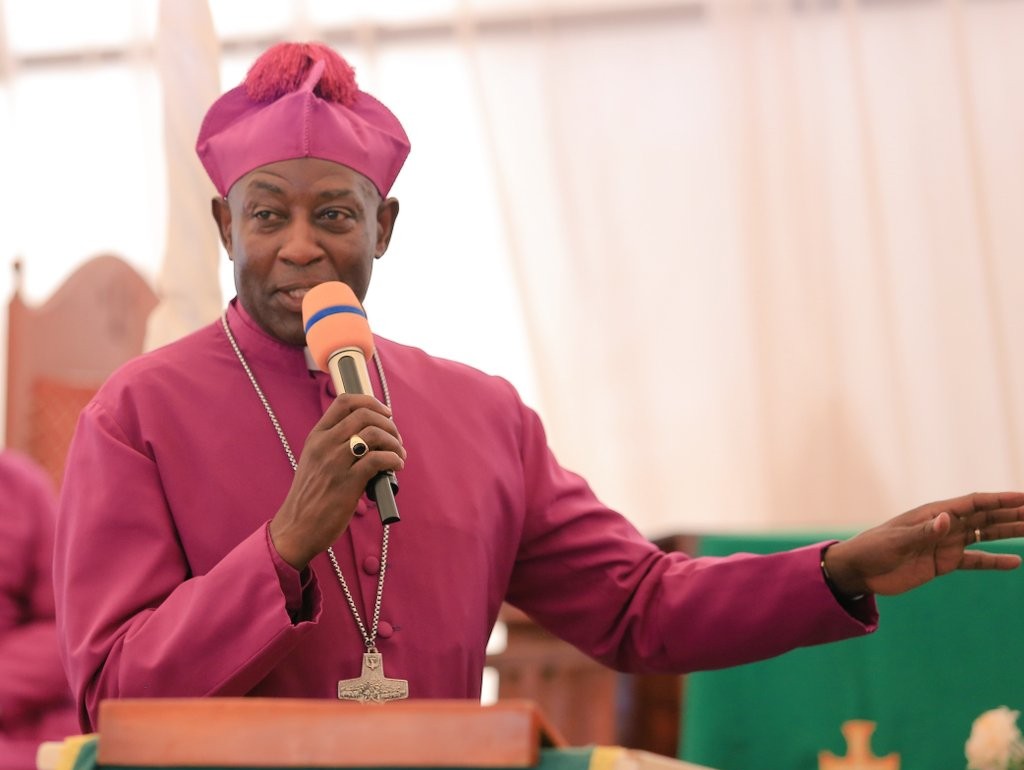

Kampala, Uganda – The Church of Uganda moved swiftly Monday to contain a wave of social media alarm, firmly rejecting claims that its Archbishop, the Most Rev. Dr. Stephen Samuel Kaziimba Mugalu, had been physically attacked during a church service in Boston over the weekend.
In an official statement issued May 4, the Church described what happened at St. Peter’s Anglican Church as a “brief disruption” caused by a small group of unidentified individuals, insisting the incident was contained before the service resumed.
“The Archbishop is currently in the United States on official duties. During a recent service in Boston, a brief disruption was caused by a small group of individuals who have not yet been identified. The situation was promptly contained, and the service proceeded without further interruption,” the statement read.
The Church added that Archbishop Kaziimba “was not harmed in any way,” and confirmed he “remains safe and continues to execute his ministry as scheduled during his international visit.” Officials urged the public to disregard what they called misleading narratives designed to create unnecessary anxiety, sharing a link to a full video of the service as verification.
Videos widely circulated on social media, however, tell a more charged story, showing a tense moment inside the church where a small group of congregants disrupted proceedings, shouted at the Archbishop, and briefly halted the service before the situation was brought under control. The Archbishop’s press secretary and communications officer, Adams Sadiiki, echoed the Church’s measured tone. “The Archbishop is on his international tour of duty, and the service went on well despite a slight disruption by an individual or two. It was contained and ministry continued,” Sadiiki said Monday. St. Peter’s Anglican Church in the Boston area serves a significant Ugandan diaspora community, conducting services in both Luganda and English.
The incident did not emerge in a vacuum. Sections of the congregation turned rowdy and demanded that the Archbishop leave, with members of the diaspora accusing him of remaining silent on pressing issues affecting Ugandans back home. It is the latest flashpoint in a simmering debate over the Archbishop’s public posture at a moment of heightened political tension in Uganda following the January 2026 general election, which saw President Yoweri Museveni secure another term amid widespread reports of opposition detentions, abductions, and alleged political repression.
Preaching April 19 at the installation of Rev. Canon Michael Mukhwana as Archdeacon of St. John’s, Makerere, Archbishop Kaziimba addressed comparisons with martyred Archbishop Janani Luwum directly, questioning the wisdom of public confrontation that leads to death. “Some people say, ‘Why don’t you do like Janani Luwum? The man who was killed! Do you think I can make an impact by being killed? Don’t I have a family?’” he said, rejecting the idea that dying would solve problems. He framed his approach in biblical terms, contrasting what he described as the “Nathan approach” with the more public witness of John the Baptist, arguing that the prophet Nathan’s private confrontation of King David achieved repentance, while John the Baptist’s public rebuke of Herod led to his execution.

Those remarks drew sharp criticism well before the Boston confrontation. Late Kalangala Woman MP Helen Nakimuli, who died April 19 after surgery, had accused religious leaders of fearing to lose government favors and urged them to speak truth to power. Her words circulated widely online in the days before her death, deepening public scrutiny on the Church and setting a tense backdrop for the Archbishop’s U.S. visit.
The shadow of Archbishop Janani Luwum looms large over this entire debate. Luwum, who served from 1974 to 1977, was arrested after protesting killings and abuses under Idi Amin’s regime and was murdered Feb. 16, 1977, in what was officially described as a car accident but is widely regarded as a deliberate assassination. He is commemorated as a martyr across the Anglican Communion, with a statue at Westminster Abbey and an annual public holiday in Uganda, with the Church marking the 49th anniversary of his death in February 2026. For many in the Ugandan diaspora, Luwum represents a standard of moral courage they believe the current Archbishop has fallen short of. For Archbishop Kaziimba, the comparison carries enormous personal weight and an uncomfortable expectation.
Elected in August 2019 and enthroned as the ninth primate of the Church of Uganda in March 2020, Kaziimba had previously served as Bishop of the Diocese of Mityana from 2009 to 2020. Under his leadership, the Church of Uganda has staked out firm positions on global Anglican debates, most notably on same sex marriage. In 2023, Kaziimba expressed support for Uganda’s Anti Homosexuality Act, disputing criticism from the then Archbishop of Canterbury and noting that laws criminalizing homosexual acts had originally been introduced to Uganda by the British during colonial times. This year, the Church carries the provincial theme “Anchored in Christ for unity, stability and peace,” drawn from Ephesians 2:14 to 17, a theme that has itself become a point of contention for those who argue stability cannot be achieved without justice.
No part of this publication or its digital content may be reproduced, distributed, published, broadcast, rewritten, or redistributed in whole or in part without prior written permission from Kalisho Info.
For inquiries, contact: kalishoinfo@gmail.com
Stay informed and ahead of the curve! Follow Kalisho Info for real-time updates and breaking news.
Follow @KalishoInfo on X